
How Mansfield Residents Are Found
A Mansfield residents directory is best understood as a set of official indexes and historical collections. The Town Clerk is the starting point for recorded land instruments, maps, trade names, vital copies, cemetery guidance, and public-record requests. AxisGIS and the Assessor connect an address or parcel number to a dated owner and assessment snapshot. The Connecticut voter system has its own public fields and privacy rules. Court and probate indexes show parties, case roles, or estate activity, not a complete household. The library, Historical Society, UConn Archives, churches, and cemetery sources help with older families and former places.
Choose the narrowest source that can answer the question. An address search should begin with USPS and the parcel map. A person search needs a name variant and a date range. A family-history search should test Mansfield, Mansfield Center, Storrs, Mansfield Depot, and the historical county labels. A missing online result may reflect a firewall, an image gate, an erased case, a closed record, or an incomplete index. It should not be read as proof that no record exists.
- Write down the name, address, postal label, approximate date, and reason for the search.
- Check the Mansfield Assessor and AxisGIS for the parcel, owner field, mailing field, assessment year, and sales clues.
- Use the Town Clerk land-record index for a deed, map, trade name, or older book and page.
- Use the Connecticut voter, court, probate, or vital-record route only when its rules fit the question.
- Move to the Mansfield Library, Historical Society, UConn, State Library, or a written FOI request when the online index stops.
That sequence gives the search a source trail. It also keeps a property owner, a registered voter, a deed party, a permit contact, and a historical household member in their proper roles.
Mansfield Resident Records Offices
There is no operating Tolland County clerk or county recorder to substitute for a Mansfield office. Connecticut counties remain useful as court, probate, and historical labels, but local land and vital records stay with the Town Clerk. The Assessor handles the Grand List and points to AxisGIS. The Registrar of Voters works within the centralized state system. State agencies handle the public voter endpoint, vital-record rules, professional credentials, and other statewide records. The office name matters because a request sent to the wrong custodian can look like a missing record.
Mansfield Town Clerk
Audrey P. Beck Building
4 S Eagleville Road
Storrs-Mansfield, CT 06268
860-429-3302
Mansfield Assessor
Audrey P. Beck Building
Storrs-Mansfield, CT 06268
860-429-3311
Mansfield Registrar of Voters
Town election and registration office
Mansfield, Connecticut
860-429-3368
The Town Clerk page is a custodian map, not an unrestricted resident roster. The Assessor’s owner and mailing fields are tax-record snapshots. The Registrar’s public result is controlled by Connecticut law, and protected voters may not display a street address. Keeping those limits visible makes the Mansfield residents directory more useful, not less.
For court matters, Mansfield is served by G.A. 19 in Rockville, while estates and trusts use the Tolland-Mansfield Probate District. A historical question may belong with the Mansfield Public Library, Mansfield Historical Society, UConn Archives, or Connecticut State Library instead. The correct office is part of the result.
Mansfield Labels Need Sorting
Mansfield, Mansfield Center, Storrs, and Storrs-Mansfield can all appear in a useful record trail. The civil town is Mansfield. The postal label can be Mansfield Center or Storrs-Mansfield. A UConn address can use an institutional ZIP that does not act like a normal townwide postal area. Tolland County is a current geographic and judicial label, while older records may use Windham County or Hartford County. These are not interchangeable fields.
When a name or address does not appear, search the town name, postal locality, road name, and historical county as separate terms. A modern parcel search should retain the legal description and parcel key. A historical search should retain the title page, collection, date, and page image. This simple sorting step prevents a Storrs campus collection from being mistaken for a separate municipality and prevents a pre-1827 county label from being discarded.
Insider tip. Record civil town, postal city, ZIP, court district, parcel number, and collection name in separate fields. One address string rarely carries all of that meaning.
Parcel Search in Mansfield AxisGIS
The fastest current address trail usually runs from the Mansfield Assessor page to AxisGIS Mansfield. The public map accepts an owner name, street or property address, and parcel number or PID. The configuration also exposes GIS and CAMA identifiers, a map identify action, sorting by owner, address, property ID, or best match, sales history, building data, and report controls. The public splash warns that the map and tax data are illustrative public information, not a field survey.
Use the parcel number as the stable key when one is available. Compare the PropertyAddress, which is the physical situs field, with OwnerAddress, which is a tax or mailing field. They may differ. AxisGIS data was identified through a 2025 configuration, while assessment and revaluation labels are date-specific. A parcel card can show an owner-of-record snapshot without proving who sleeps at the address today.
For an ordinary parcel search, enter enough of the owner or street to trigger the portal, choose the matching result, save the PID or GIS number, and note the assessment year. Then compare the map position with USPS and, when useful, the Mansfield permit case status portal. Do not copy a live private-person card into a public directory. A source link, parcel key, date, and role are usually enough.
The Mansfield Assessor information explains the Grand List, taxable and tax-exempt property, motor vehicles, personal property, revaluation, and exemption programs. Those categories explain why an entry can have a name and address signal without being a complete current-resident list.
| AxisGIS field | What it helps establish |
|---|---|
| OwnerName | Name printed in the parcel record at the data date. |
| PropertyAddress | Physical parcel location used for map and permit comparison. |
| OwnerAddress | Tax or mailing address, which may be outside Mansfield. |
| PID / CAMA / GIS number | Cross-system key for tying the parcel to maps and requests. |
| Assessment and sales data | Dated property and sale fields, not a continuous household history. |
The official Mansfield Assessor page is the best place to see how the town routes property questions into its public map and assessment tools.
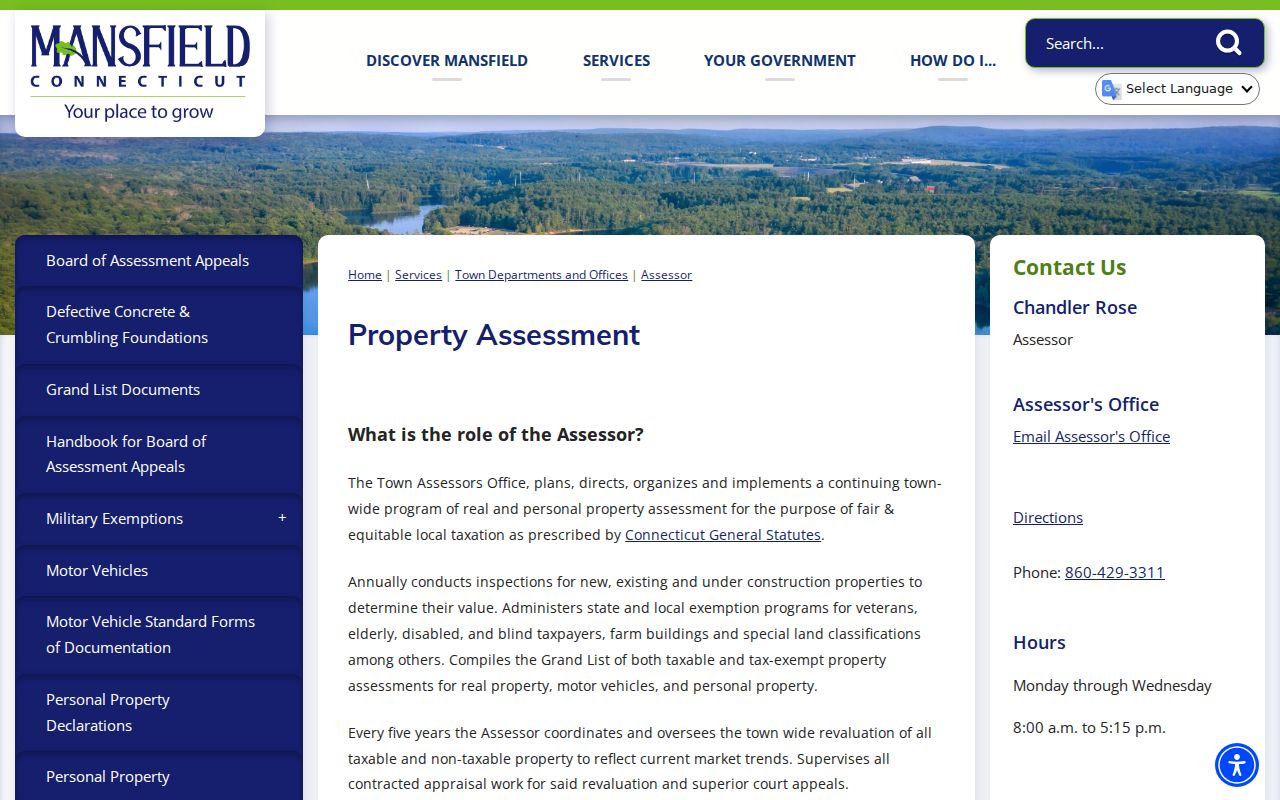
The screenshot belongs with the dated portal description, because AxisGIS labels, reports, and assessment years can change without changing the parcel itself.
Deeds Connect Mansfield Addresses
Mansfield land records reach from 1702 forward. Current RecordHub coverage begins with volume 122 on May 19, 1973, while earlier books and Online Index Books cover the older chain. The Town’s simple route uses the “Book Page” selector and identifies early material with PR1, RB1, or RB1A. Proprietor’s Records cover 1702 through 1730. A result may be visible in an index even when the document image or download requires an account, subscription, or payment.
Search a grantor and grantee separately. In plain terms, the grantor transfers an interest and the grantee receives it. Test exact names, initials, spelling variants, trustees, estates, corporations, and a second party. Add a date window. Log the document type, book and page, recording date, instrument date, legal description, related map, and image-access status. An index hit tells you that a named party appeared in a recorded instrument. It does not, by itself, prove current ownership or residence.
The Mansfield Land Records page is also the route to historic birth, marriage, death, and trade-name indexes. The map indexes add street name, map title, book, page, filed date, and description fields. Follow a map reference into the deed index rather than treating a map title as a conveyance.
RecordHub’s expanded search can use a last name, first-name variants, index or document types, date range, a second name, and begins-with or contains behavior. Vendor guidance says simple search uses exact matching by default, implied AND behavior, quoted grouping, and a trailing wildcard. Recheck the live controls before relying on a particular option.
The Town’s land-record instructions show the distinction between a modern vendor index and the historic books that support earlier Mansfield research.
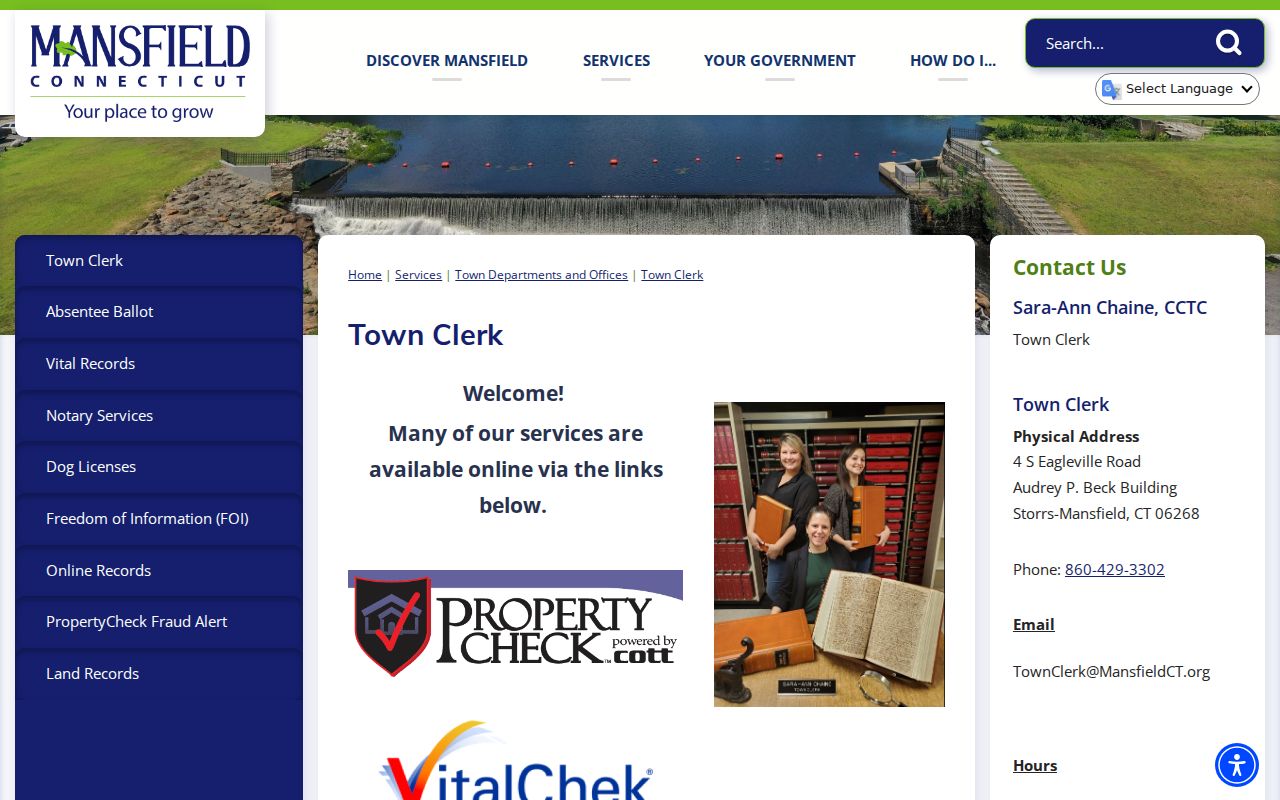
That distinction matters when an older Mansfield name is missing from a simple modern search and the next step is an Online Index Book or Town Clerk request.
Connecticut Voter Lookup Rules
The Connecticut Secretary of the State maintains the centralized voter system used by all towns, including Mansfield. The public lookup is intended to narrow by town, first name, last name, and date of birth, but the endpoint returned a web-application firewall response during research. A failed automated capture is not evidence that a Mansfield record is absent. Use the official endpoint in a normal browser, note the access date, and never bypass a control.
Current law makes only the year of birth public in the ordinary display. Name, permitted address or mailing information, voting district, party or status, registration date, and participation-history fields may appear subject to the live rules. A result does not show a ballot choice, prove election-day presence, or establish ownership. The statewide CSV is a separate SOTS product, listed at $300, delivered as a CSV, and limited to certified election-related, scholarly, journalistic, political, or governmental purposes.
The Mansfield Registrar of Voters supplies the local office context, while the state controls the centralized record and public field definitions. Protected voter addresses may be suppressed or replaced. Treat a protected or redacted field as a legal privacy measure, not a research mistake.
The state lookup remains the source for the current public search route.
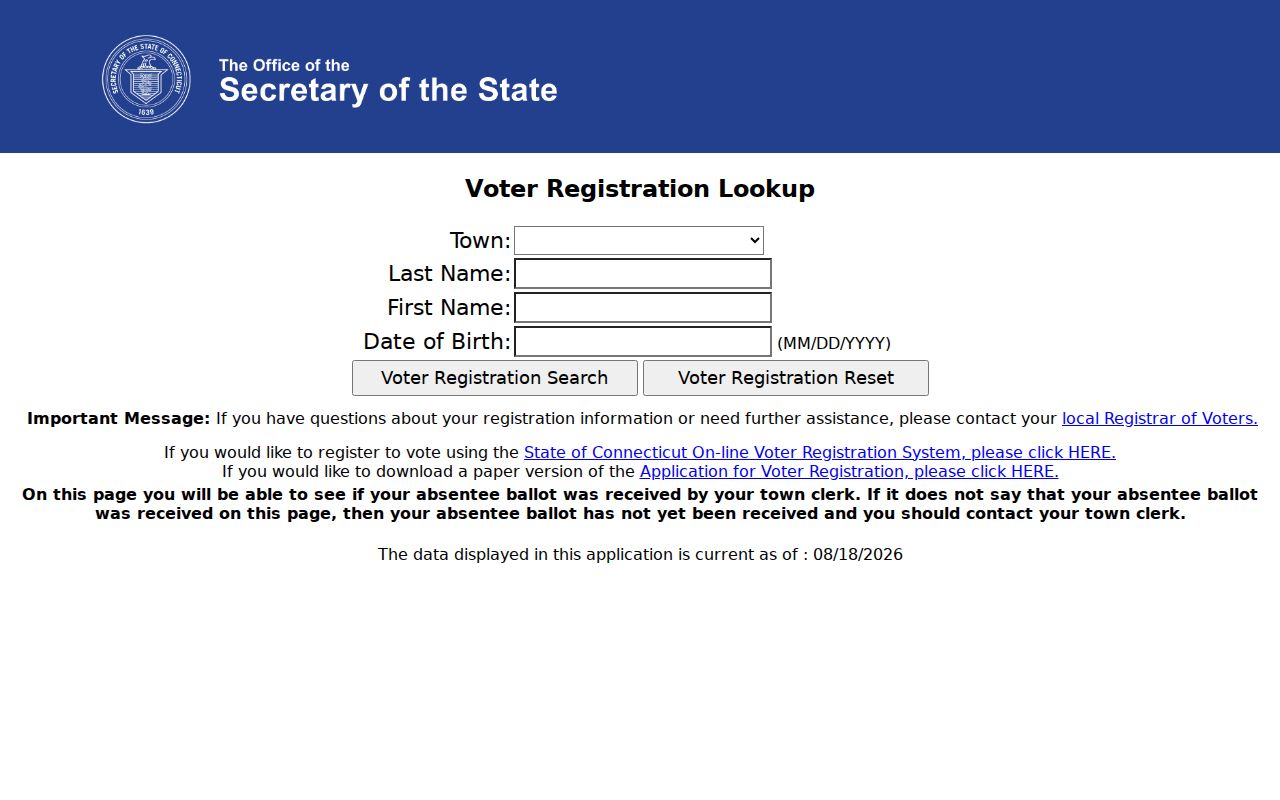
The capture preserves the source and its limitations without publishing a private voter result or full date of birth.
The local Mansfield Registrar of Voters page explains the town-side registration and election role.

Use it to distinguish a local contact from the centralized state lookup and its changing public-field rules.
Current Mansfield Resident Directories
Current resident information in Mansfield is distributed across records with different meanings. The table below is a coverage map, not a promise of a single list of every household. The best answer usually combines two or more compatible sources, while keeping each source’s role and date visible.
| Source | Who or what appears | Keeper | Access and caution |
|---|---|---|---|
| AxisGIS parcel record | Owner, mailing field, parcel, assessment and sales clues | Mansfield Assessor | Public map, dated snapshot, not an occupant list |
| Town deed index | Grantors, grantees, trustees, map owners and trade-name filers | Mansfield Town Clerk | 1702 forward, images and older indexes vary |
| Voter lookup | Permitted registration, district, status and participation fields | Connecticut SOTS and local Registrar | Statutory access, privacy and year-of-birth limits |
| Permit case status | Address, APN, owner/contact, project and permit dates | Mansfield OnlineGovt | Project record, date span not verified |
| Vital or probate record | Life event, estate, fiduciary, family or court role | Town, DPH, or Probate Court | Eligibility and document-access rules apply |
For a single person, compare role and date before name similarity. For a street, parcel and deed keys are stronger than a name alone. For an old family, an index, church, census, cemetery, or archive source may be more useful than a current owner field. The detailed one-person route is in the Mansfield resident lookup page.
Vital Records and Mansfield Families
The Mansfield Vital Records office and Connecticut DPH provide different ordering paths. The town where an event occurred is generally the faster local route. The statewide registry begins July 1, 1897, while pre-1897 material stays with local books, historical collections, church sources, family Bibles, and genealogy films. State processing can reach 12 weeks. Local and state forms ask for event details, requester identity, relationship or eligibility, identification, copy type, number of copies, and payment.
Birth and fetal-death records under 100 years are restricted under C.G.S. §7-51. Adults can generally purchase certified marriage or death copies under C.G.S. §7-51a(a), but SSN fields and adoption, parentage, surrogacy, and gender-change material remain protected. A marriage or death location is a life-event fact, not proof of a current Mansfield address. Keep the source date and form revision with any research note.
Begin with the official Mansfield Vital Records page before choosing a local or state form.
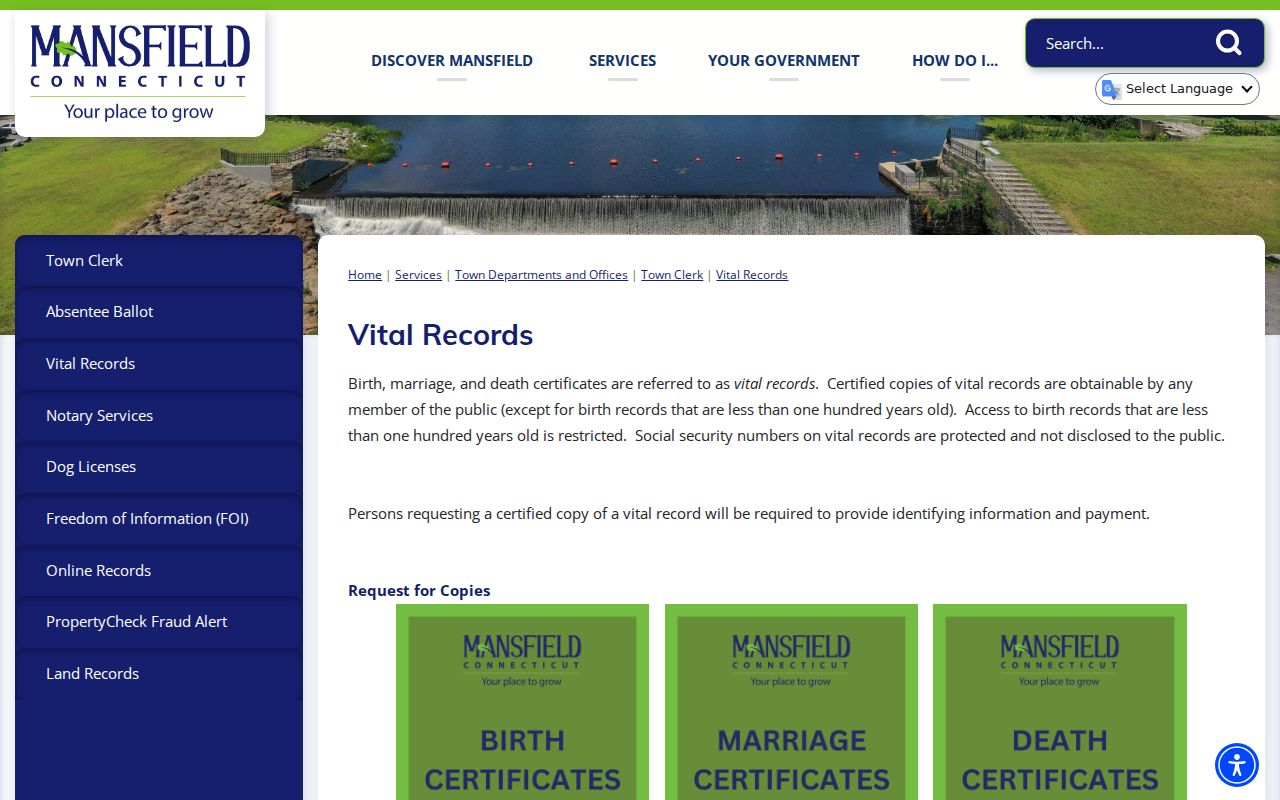
The town route is especially useful when the event occurred in Mansfield and a certified copy, index question, or historic-record handoff is needed.
The Connecticut DPH ordering instructions show the statewide route and its eligibility, payment, and timing differences.
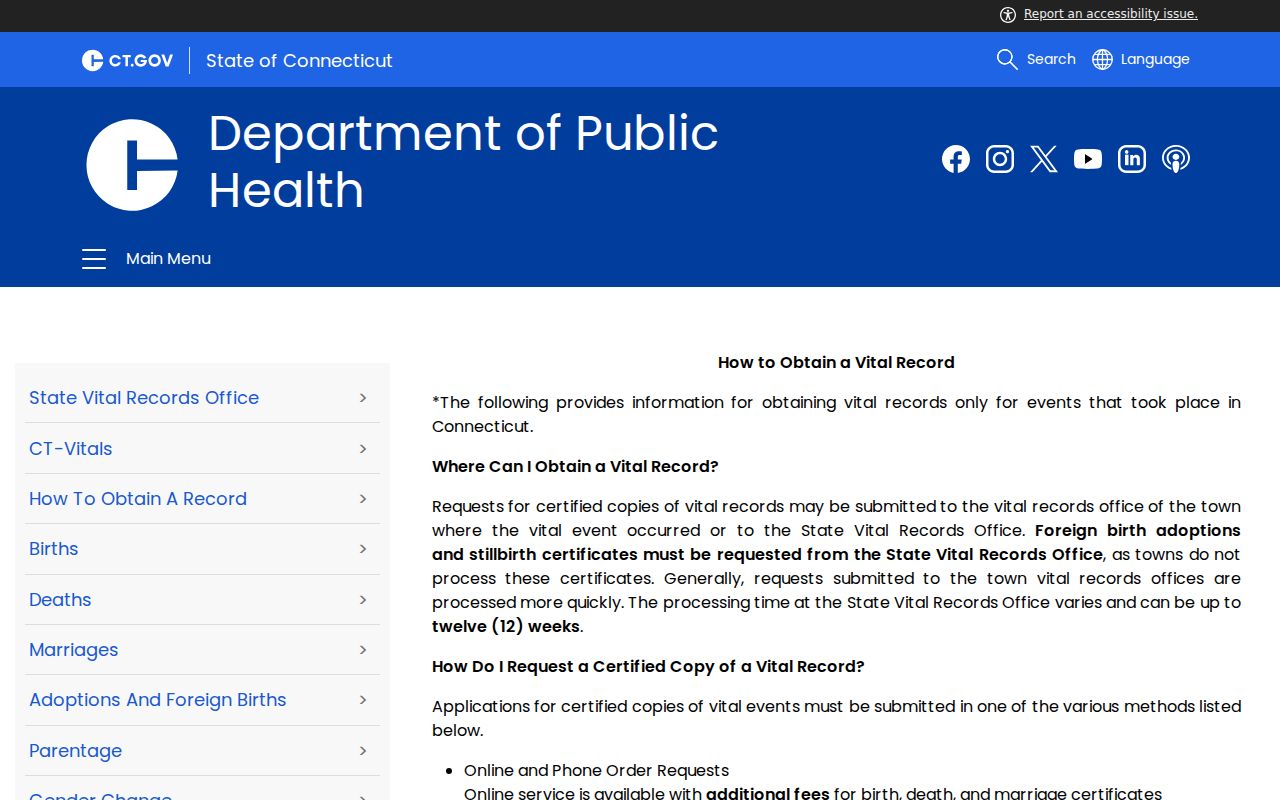
Use the town and state instructions together, because a local $20 copy route and a state $30 birth route are not the same request.
Mansfield Court and Probate Searches
Mansfield trial-court records route through Connecticut Judicial Branch systems and G.A. 19 in Rockville, not a county clerk. Civil party search is name-oriented and can lead to a docket, case type, court location, party role, filing date, disposition, and detail. Online information is a public service, not the official file. Display windows, erasure, juvenile protections, protected parties, and removed cases can all affect a name search.
Estate and trust matters use the Tolland-Mansfield Probate District, PD-25. Public Decedent Estates and Trusts data begins January 5, 2011. Search fields include district, case type, status, first name, and last name. A result can identify a decedent, fiduciary, attorney, or interested party, so role matters. Documents are not a free general dump; interested parties, attorneys, and self-represented parties follow the court’s access process.
When a result matters, log the exact query, source date, case or docket number, role, status, and court. A clean search should be written as “no result located in the official index searched on” a stated date. That wording separates a negative result from an erased record, a spelling mismatch, a firewall failure, or a case outside the display window.
Reading Mansfield Record Terms
A few plain definitions keep the Mansfield residents directory from overclaiming what a record says. The same name can appear in more than one role, and one record can answer only one part of a question.
- Roll
- A recurring official list, such as the Grand List or voter registration record, with its own date and access rules.
- Index
- A finding aid that points to a record, book, page, docket, or image. It is not always the full document.
- Parcel
- A mapped piece of land identified by a PID, CAMA, GIS number, legal description, or map reference.
- Criss-cross directory
- An address-to-name directory, if a local historical volume can be located. Mansfield’s complete local run was not verified.
- Certified copy
- A copy issued through the custodian’s formal process, often with eligibility, ID, payment, or access rules.
Lawful personal use. Public record access does not authorize a compiled dossier, repeated unwanted contact, or location tracking. Use the smallest record detail needed for family history, civic research, reconnecting, property context, or personal safety, and respect protected addresses.
Historical Mansfield Resident Directories
Mansfield’s historical directory shelf is a research trail, not a verified complete annual run. A secondary lead titled “Mansfield City Directory, 1890” appears through the library’s MyHeritage route, but the publisher, scan, page sequence, and complete coverage were not inspected. The Mansfield Public Library confirms Ancestry Library Edition on site, MyHeritage access with a Mansfield library card, researchIT CT, HeritageQuest, historical newspapers, iCONN Newsstand, and a Local History Archive. The library’s 1795 Social Library Society and 1911 town-library history help explain why its reference collections matter.
The Mansfield Historical Society’s Edith Mason Library holds more than 500 catalogued books and about 3,000 manuscripts, including letters, diaries, maps, photographs, account books, and Old Houses Documentation Files. UConn adds Mansfield deeds from 1702 through 1756 on a chronological reel with no index, plus church, school, agricultural, organization, and family-photo collections. Connecticut State Library guides point to census, directory, probate, church, Bible, and archive finding aids. The historical county sequence, Hartford 1694-1726, Windham 1726-1827, Tolland 1827 forward, should be carried into each catalog search.
Use historical directories and archives to trace a household, place, organization, or former owner. Record the exact title, publisher, year, page, entry type, address, printed occupation or relationship, source location, and coverage caveat. The Mansfield city directories page carries the collection-by-collection method.
The Connecticut State Library genealogy guide is a useful starting point for the statewide catalog and finding aids.
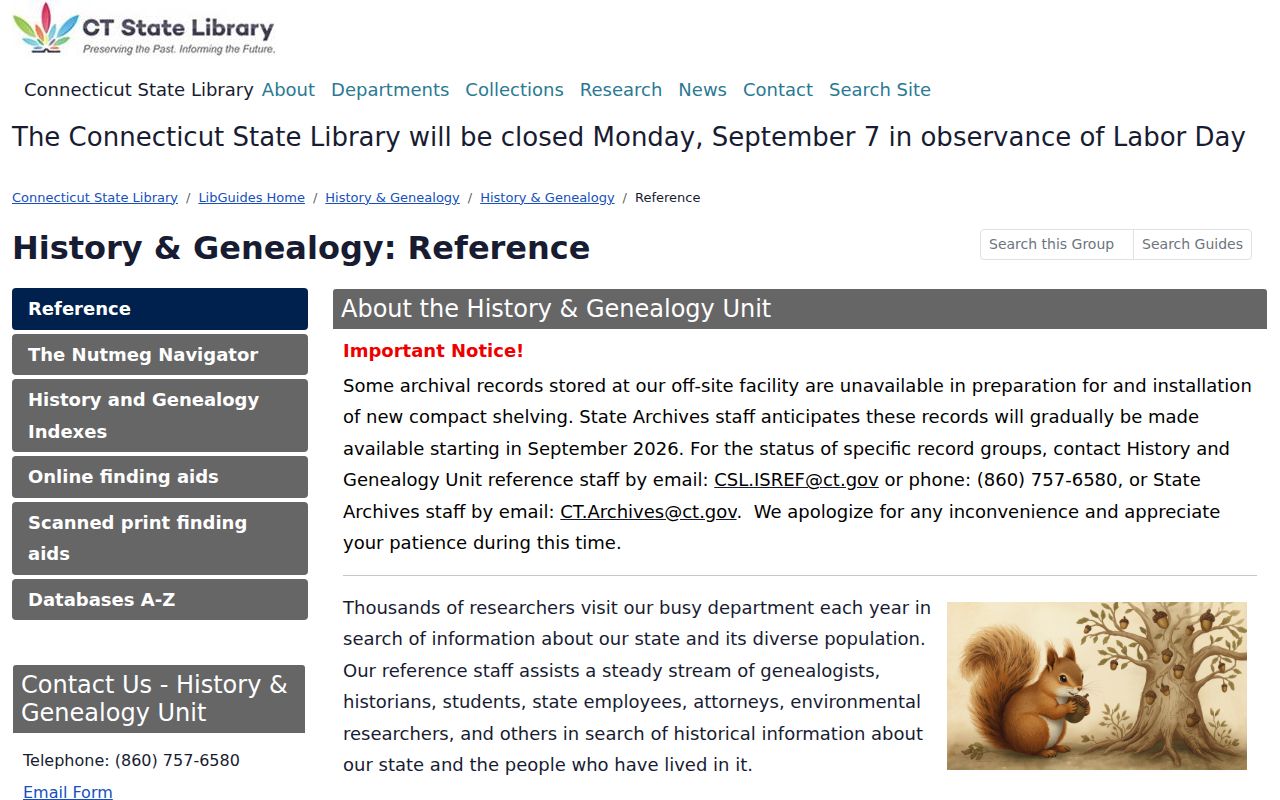
It helps place Mansfield material under the right town, county, church, family, or collection label when a modern keyword misses an older record.
Official Rolls Versus Profile Services
Commercial profile services may combine public-record extracts and licensed data into a name or address page, but they are not a substitute for a Mansfield custodian. Their freshness, identity matching, fees, and deletion process vary. Official records are narrower, yet their keeper, date, field meaning, and access rule can be checked. The useful choice depends on the question, not on how many fields a result page displays.
| Route | Strength | Limit |
|---|---|---|
| Town Clerk index | Recorded instrument, parties, book and page | Not current occupancy; image access may vary |
| Assessor and AxisGIS | Parcel, owner, mailing, assessment and map fields | Dated tax snapshot, not a household list |
| State voter route | Permitted registration and district fields | Privacy rules, protected voters, no ballot choice |
| Historical collection | Former households, places, organizations and context | Collection gaps, access restrictions, date limits |
| Commercial profile category | May surface a lead for further checking | Unverified identity, unclear source dates, variable fees |
For a defensible result, cite the official source and state exactly what it confirms. If two records disagree, do not merge them by intuition. Record the competing roles, dates, parcel or docket key, and the next custodian to ask.
Mansfield FOI When Indexes Stop
The Connecticut Freedom of Information Act, Chapter 14, C.G.S. §§1-200 onward, gives a person a route to inspect or receive copies of public records subject to exemptions. Mansfield asks for a written, date-stamped request addressed to the Town Clerk. Include the record type, person, parcel, department, date range, useful keywords, contact information, and whether inspection, paper, or electronic delivery is preferred. The Town says it acknowledges requests within four business days.
Non-state copy fees may reach 50 cents per page, state copy fees may reach 25 cents per page, and actual-cost media or printouts may apply. A prepayment can be required when an estimate is at least $10. Exemptions can cover law enforcement, juvenile, victim, medical, attorney-client, security, election, and protected privacy material. If access is denied, preserve the request, response, redactions, fee estimate, and appeal date. A Connecticut FOI Commission appeal is generally due within 30 days.
The Connecticut FOI Act provides the statewide legal framework.
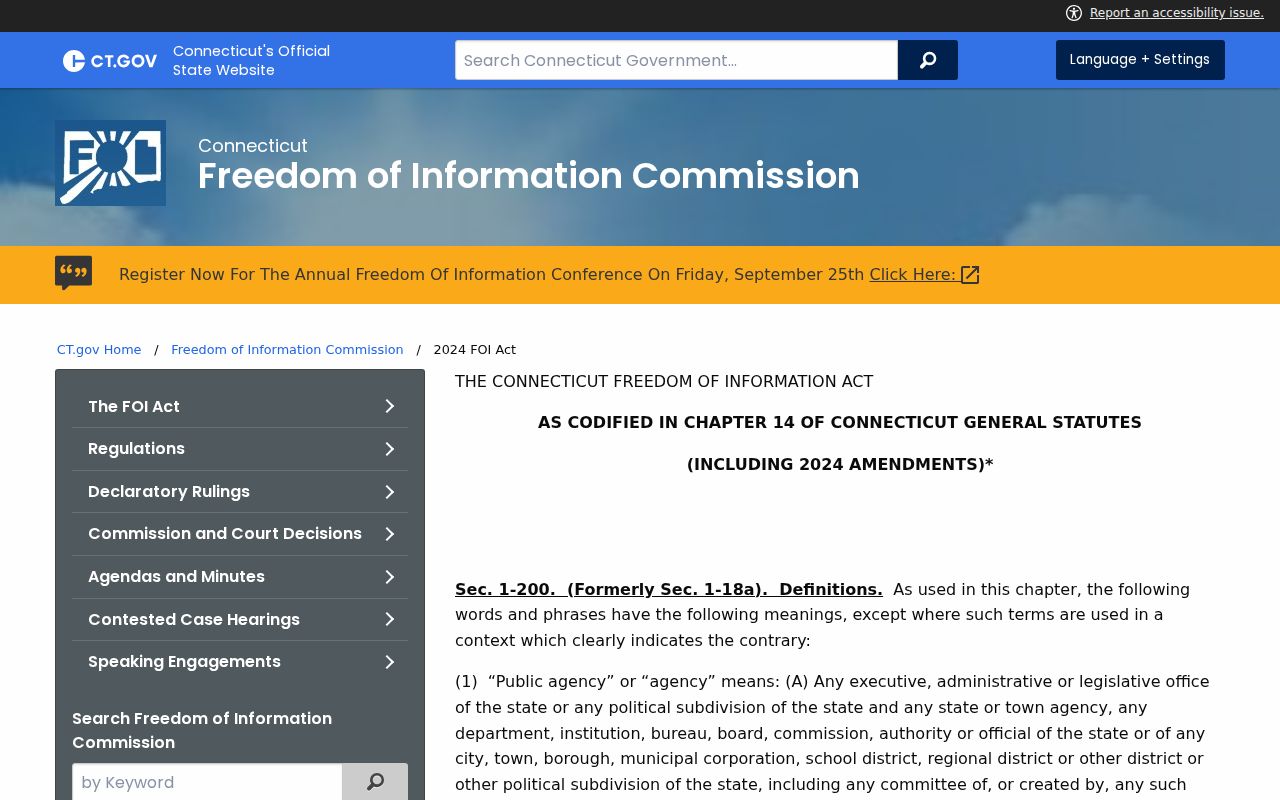
The state page supplies the statute context, while the Mansfield procedure sets the practical custodian and request path.
The local Mansfield FOI instructions are the place to check current contact and delivery details.
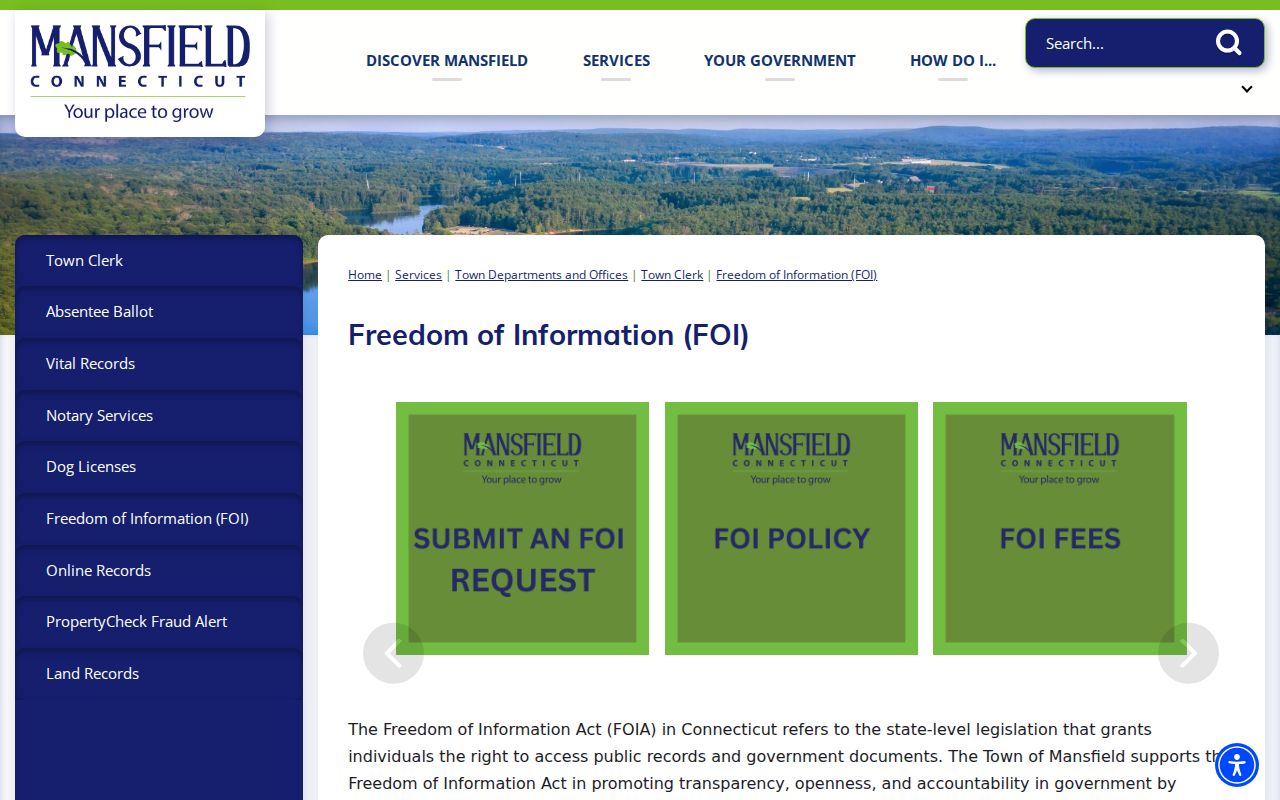
A focused request is easier to route than an unlimited demand for every record about a person or property.