
Mansfield City Directory Collections
Mansfield has a town-centered records system, so a historical directory search begins with the Mansfield Public Library, Historical Society, UConn Archives, Connecticut State Library, and catalogs rather than a Tolland County recorder. The table separates verified holdings from leads because no complete official residential or telephone run was located.
| Collection | Years / Publisher | Where Held | Access and status |
|---|---|---|---|
| Mansfield historical directory lead | “Mansfield City Directory, 1890”; publisher and full run not located in official sources | Mansfield Library MyHeritage Library Edition route | Remote with a Mansfield library card; scan, page sequence, and coverage are unverified |
| Reverse or criss-cross directory | Mansfield years and publisher not located in official sources | Library, Connecticut State Library, and Historical Society catalogs | No verified local run or digitized sample was located |
| UConn Women’s Club yearbooks or member directories | Organization founded 1903; exact years not located; archive notes a ten-year restriction | UConn Archives | Organization material, not a townwide resident volume |
| Old Houses Documentation Files | Exact file years not located; historic property files | Mansfield Historical Society, Edith Mason Library | Non-circulating, appointment-oriented historical clues |
| Map and civic record companions | Map indexes begin 1913; street-name section covers January 1, 1927 through December 31, 2024 | Town Clerk PDFs, town archive, and public meeting records | Address, place, and public-role context, not a resident roster |
The table has a deliberate gap: the 1890 title is a secondary-index lead associated with MyHeritage, not a verified publication run. The library confirms MyHeritage Library Edition access, but the publisher, image, page order, and exact years must be checked in the live collection before a citation is made.
Mansfield Library Route to a Directory
The Mansfield Library Research page is the practical first stop. It points researchers to the Local History Archive, Ancestry Library Edition for on-site use, MyHeritage Library Edition for remote use with a Mansfield library card, researchIT CT, HeritageQuest, historical newspapers, and iCONN Newsstand. Those resources can reveal a catalog title or a scanned page, but a database hit still needs a title-page check, a year check, and a page or image citation.
The main library is at 54 Warrenville Road in Mansfield Center, with Library Express at 23 Royce Circle and Maple Road at 303 Maple Road in Storrs. These are collection locations, not residence evidence. Ask for the title, publisher, year, and access condition, and record whether a card, on-site session, or staff request is required.
The Mansfield Library research page is the source for this database and local-history route.
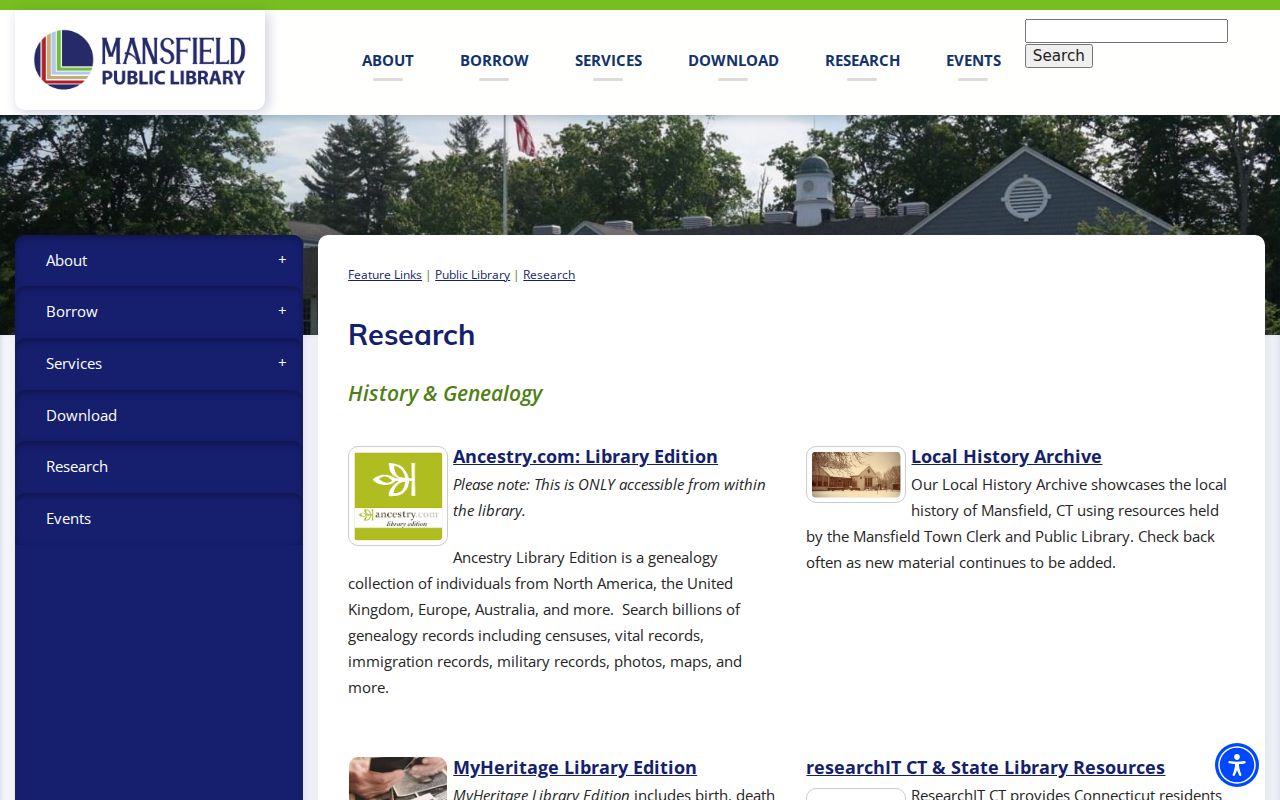
The library page supports discovery and access, but it does not claim a complete local run or an unrestricted list of residents.
The library’s history reaches to the 1795 Social Library Society and the Town’s acceptance of Mansfield Center Library in 1911. Those dates can explain an old catalog or donor clue, but they do not make the institutional history a name index.
The library About page supplies the institutional-history context for this research route.
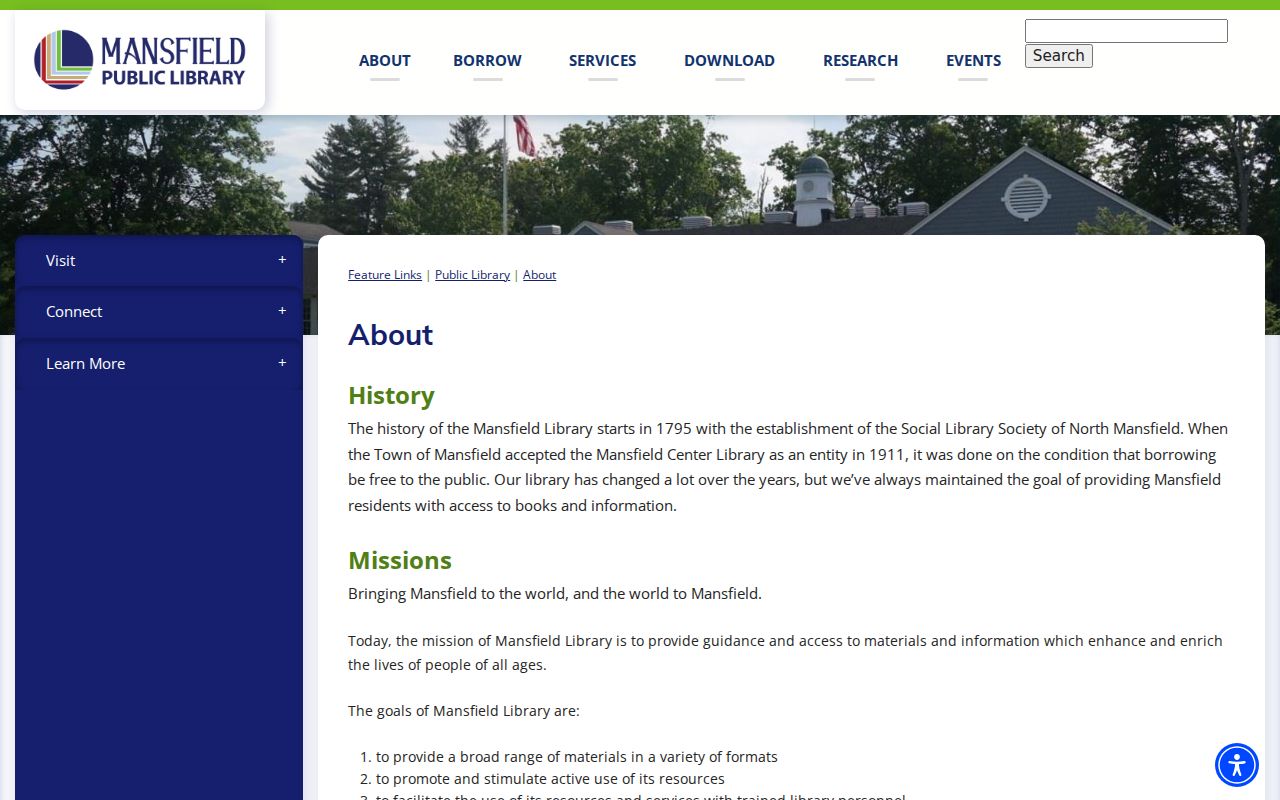
Use the library history as context for finding older materials, then cite the actual collection or archive item that contains a name.
Mansfield's 1890 Directory Lead
An insider tip is to treat “Mansfield City Directory, 1890” as a question, not proof of an annual series. It surfaced in a secondary MyHeritage index. The library confirms MyHeritage access, but the scan, publisher, page order, and coverage were not inspected.
Before citing it, capture the title page, year, publisher, page or image, entry type, and access date. If only a result label appears, write “unverified lead.” Do not guess missing years or assume coverage of every rural road, Storrs institution, Mansfield Center address, or nearby locality.
Insider tip. A catalog title is a lead until the image, title page, publisher, year, page, and locality coverage have all been checked.
Edith Mason Library and Mansfield House Files
The Mansfield Historical Society’s non-circulating Edith Mason Library describes more than 500 catalogued books and roughly 3,000 manuscripts from the eighteenth century to the present. Letters, account books, diaries, maps, photographs, and Old Houses Documentation Files can connect a surname or address to local history.
Old Houses files may contain an architectural description, former-occupant clue, photograph, map, or narrative. Pair them with a Town Clerk deed, map index, or parcel source before describing ownership. The appointment-oriented research service lists P.O. Box 145, 954 Storrs Road, phone 860-429-6575, and copying or scanning rules. Ask the archivist to distinguish a directory page from a manuscript reference.
UConn Storrs Sources Beyond a City Directory
UConn Archives and Special Collections add an institutional layer to Mansfield research. Connecticut History and Culture finding aids point to farmer, merchant, and shoemaker diaries, town, county, church, and Grange histories, and Storrs organizations. These are collection leads, not current resident directories.
The Storrs guide names Women’s Club Records, founded in 1903, Storrs Agricultural Experiment Station materials, a 1948 Mansfield World Federalist Association chapter, Storrs Congregational Church, Edwin O. Smith High School, and Storrs family photographs. Women’s Club yearbooks have a noted ten-year restriction and unknown exact years, so they are not a townwide list.
The UConn Storrs and Mansfield guide is the source for these named collection leads.
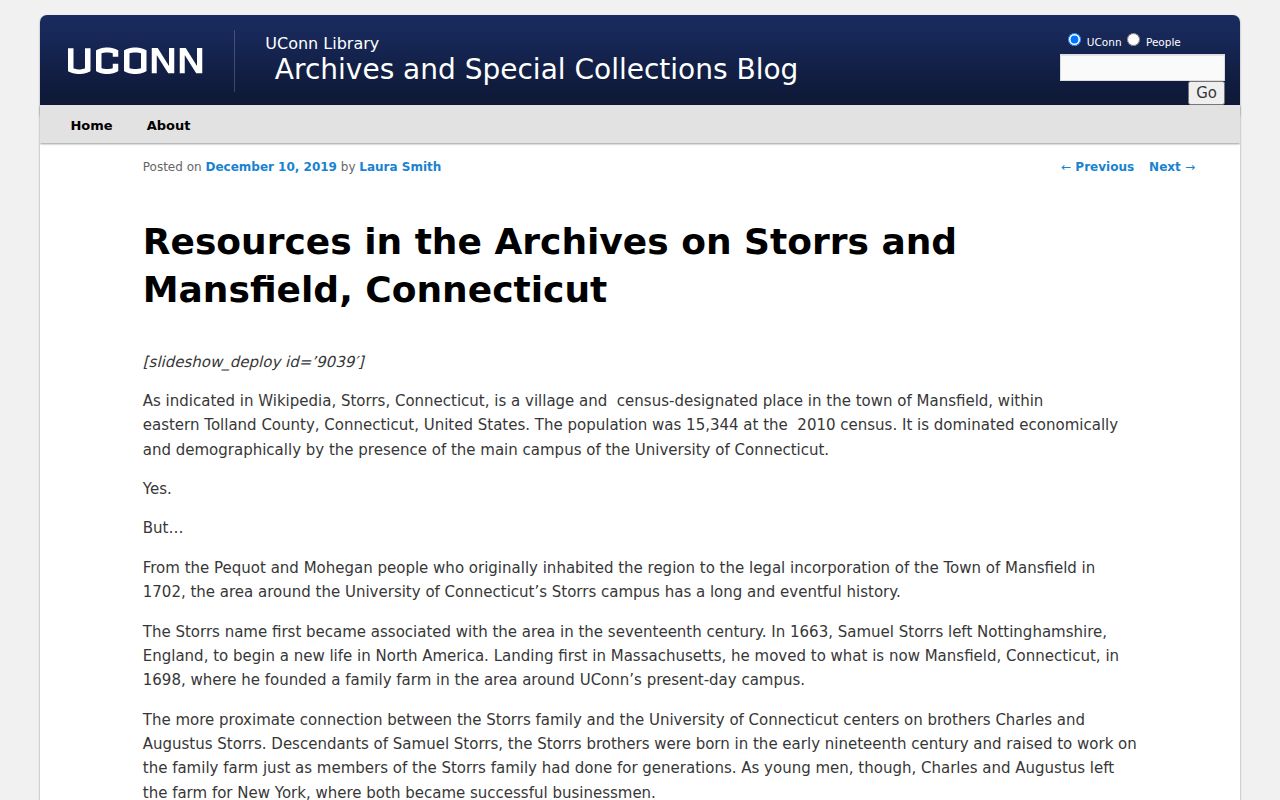
A family, school, church, or organization question may belong in a finding aid instead of a printed directory search.
The UConn microform guide lists “Town of Mansfield, Connecticut: Deeds 1702–1756,” one chronological reel with no index, and a 1935 “Story of Mansfield” compiled by Wormwood Hill School. The deed reel supports early land and family research but requires page-by-page reading.
The UConn Connecticut History and Culture collections page is the source for the broader archive and finding-aid route.
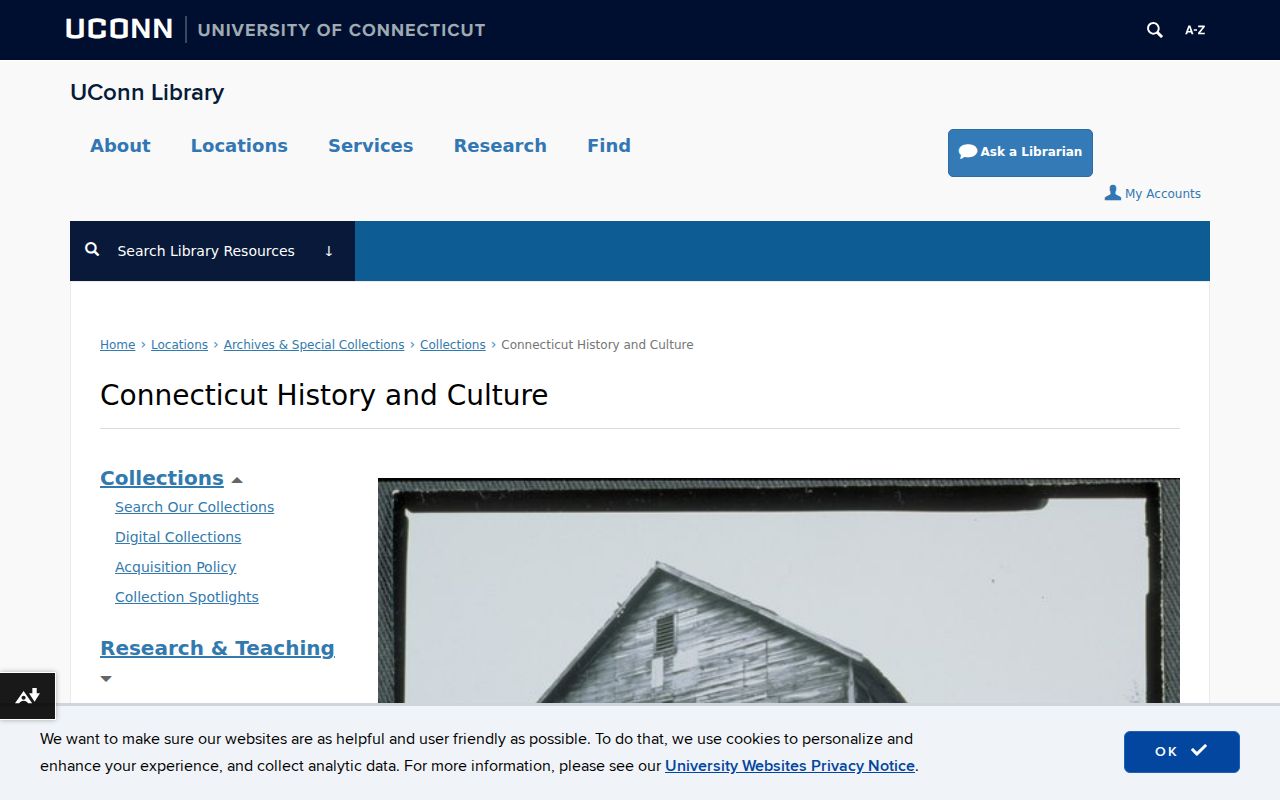
Use the collection name, finding aid, reel description, and access restriction in the citation so an archive lead can be checked later.
Mansfield Directory Searches Need Old County Labels
Mansfield was established in 1702, but older records may use Hartford County, 1694–1726, Windham County, 1726–1827, or Tolland County from 1827 forward. A family, farm, church, or deed may therefore use a historical county or parish name instead of modern Mansfield.
Test Mansfield Center, Storrs, Mansfield Depot, Tolland, Windham, and Hartford County. Keep civil town, postal label, institutional address, and historical county separate so a missing catalog hit can be tested against newspapers, church records, and finding aids.
Reading a Mansfield City Directory Entry
No Mansfield directory image or local directory entry was directly inspected in the research pass. The following sample-entry inventory is therefore a capture checklist, not a fabricated transcription. When an image is found, preserve the printed spelling and the page context before interpreting a line.
| Name | Exact printed name, initials, suffix, or household head; do not expand an abbreviation without support. |
|---|---|
| Occupation | Use only the occupation printed in the entry, if any; it is a historical descriptor, not a present-day identity proof. |
| Spouse or relationship | Record a spouse, widow notation, or relationship only when the volume states it. |
| Address | Copy the house number, street, locality label, and any business or institution designation exactly. |
| Owner or renter mark | Log an owner/renter symbol when present, but do not treat a historical mark as a current status. |
| Source location | Record title page, publisher, year, page or image, collection, URL, access date, and coverage caveat. |
- Criss-cross directory
- An address- or street-ordered section that can be used to move from a place to a name. Mansfield years and publisher were not verified, so its local availability must be checked.
- Householder index
- A name-centered index of household heads or listed residents. It is an index to the volume’s own coverage, not a complete census of everyone in town.
- Abbreviation key
- The volume’s explanation of short forms and symbols. Photograph or transcribe it before reading entries so marks such as widow, residence, board, or ownership are not guessed.
Church, Cemetery, Civic Records Fill Gaps
The Connecticut State Library guide links church, probate, vital, census, printed-directory, old-house, and family-Bible sources, and notes thousands of family records, some digitized. The Mansfield Town Guide identifies First Congregational Church records from 1710 through 1927 and local vital holdings around 1845 through 1905. Keep church membership separate from civil residence.
The Town lists 21 known cemeteries but no verified public interment-name index, so a cemetery page is a place lead. The Town archive, Boards and Committees directory, Agenda Center, and Downtown Partnership document public roles and civic organizations, not private households. FamilySearch filmed records are catalog leads, not proof that every image is online or indexed.
The FamilySearch Mansfield catalog is the source for this filmed-record lead.
Use the catalog item, film note, and viewer condition in the source trail, then verify important facts against a town, church, or original record.
Mansfield Directory Timeline With Honest Gaps
This timeline uses only dates surfaced in Mansfield research. It does not claim that any date marks the first or last printed volume. The 1890 item remains an unverified lead, while the archive and records dates below describe the setting in which directory clues may be found.
| Date | What the source establishes | How it helps the search |
|---|---|---|
| 1694–1726 | Mansfield-area records can carry Hartford County labels | Test the historical county when a modern town search misses an early family |
| 1702 | Mansfield was established | Use the town’s early land and vital context for family reconstruction |
| 1726–1827 | The county label changed to Windham | Search Windham and parish variants in catalogs and church sources |
| 1795 | Social Library Society history is recorded | Older catalog and donor clues may be library-centered |
| 1827–present | Tolland County is the current county label | Use Tolland for later probate, court, and genealogy routing |
| 1890 | The title appears as a secondary MyHeritage lead | Verify the image and publisher; do not call it a complete run |
| 1903 and 1948 | Named Storrs and Mansfield organization records are identified by UConn | Use organization archives as companion sources, not townwide directories |
| 1927–2024 | Town street-name map index section is continuous for the stated span | Bridge a historic address clue to a map book/page and parcel trail |
Using Mansfield City Directories for Family History
A careful directory-and-census trace treats each volume as a dated snapshot. Start with a question such as “Where was this family recorded?” or “Which address connects this name to a church, farm, or school?” Do not treat a single line as proof of a full household or a current resident.
- Normalize the name, street, locality, and historical county. Save Mansfield Center, Storrs, Mansfield Depot, Windham, and Hartford variants before searching.
- Begin with the oldest verified volume. Test the 1890 MyHeritage title only as an unverified lead, and capture its title page, publisher, year, page, image, and access condition.
- Repeat each verified year by surname, given name, street, and business or organization label. Keep a household table with exact entry text, address, occupation if printed, owner/renter mark, and uncertainty.
- Pair directory years with publicly released federal census years through 1950 under the 72-year rule. Compare household members, ages, birthplace, and occupation without treating the census as a continuous address log.
- Use deeds, map indexes, church records, vital indexes, cemetery leads, obituaries, probate, or archive files to explain a move or close a historical trail.
- If the street or number changed, bridge it with a parcel or map book/page, legal description, historic-house title, nearby road, and source date. If a name disappears, record moved, died, unlisted, or unresolved as separate possibilities.
When a historical entry needs a present-day role check, continue to the Resident Lookup workflow. For current parcel and address records, use the By Street page rather than extending a historical directory beyond what it can show. A precise citation keeps the trail reproducible.